A Conversation with Xinyue and Tony on Nepal, Bhutan, Buddhist Practice, Silence, and the Inner Road
There are journeys we choose.
And then there are journeys that seem to have been quietly choosing us for years.
When I sat down with Xinyue and Tony, I did not want this to feel like a formal interview. Interviews can sometimes make people perform clarity. I was hoping for something more alive: a conversation where people speak from memory, laugh a little, resist easy labels, and occasionally reveal something much deeper than they planned.
Xinyue and Tony are the co-creators of retreat-travel journeys to Nepal and Bhutan, and the founders of Fanjing, a spiritual aesthetics space. But even that description is too tidy. Their work did not begin as a business plan. It grew out of art, mountains, environmental work, Buddhist practice, silence, design, local friendships, travel mishaps, and the mysterious way life arranges causes and conditions long before we understand them.
In Buddhist language, we might call it dependent origination.
In ordinary language, we might say: one thing led to another.
And perhaps that is how most real pilgrimages begin.
What Is Retreat-Travel?
Retreat-Travel as Practice, Not Performance
Before we enter Nepal, Bhutan, Everest, sound healing, meditation, and all the beautiful things that make people want to pack a linen shirt and become temporarily profound, we should ask the simplest question first:
What is retreat-travel?
It is not simply tourism with meditation added on top.
It is not a vacation with incense.
It is not a spiritual product with a Himalayan backdrop.
At least, not when it is done sincerely.
Retreat-travel, as Xinyue and Tony describe it, is a way of using outer movement to create inner stillness. The destination matters, but the destination is not the point. The itinerary matters, but the itinerary is not the heart. The real journey is what happens when a person leaves the habitual track of daily life and begins to see, feel, and question from another place.
Why Nepal and Bhutan Matter
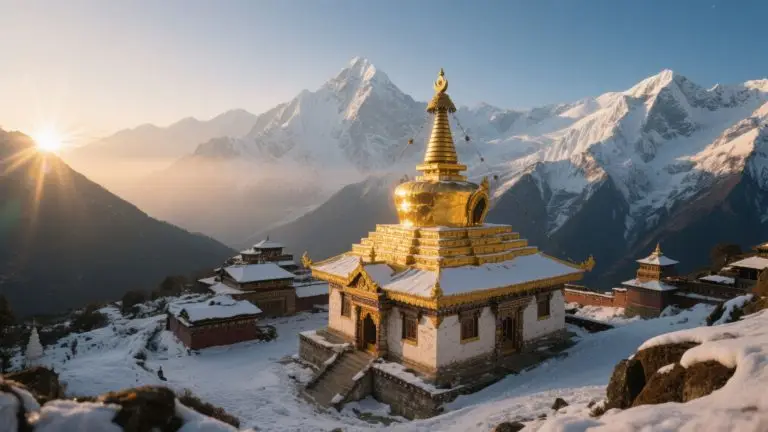
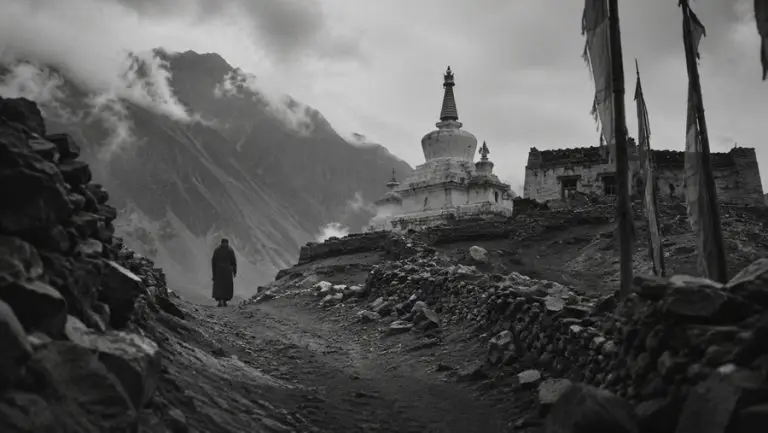
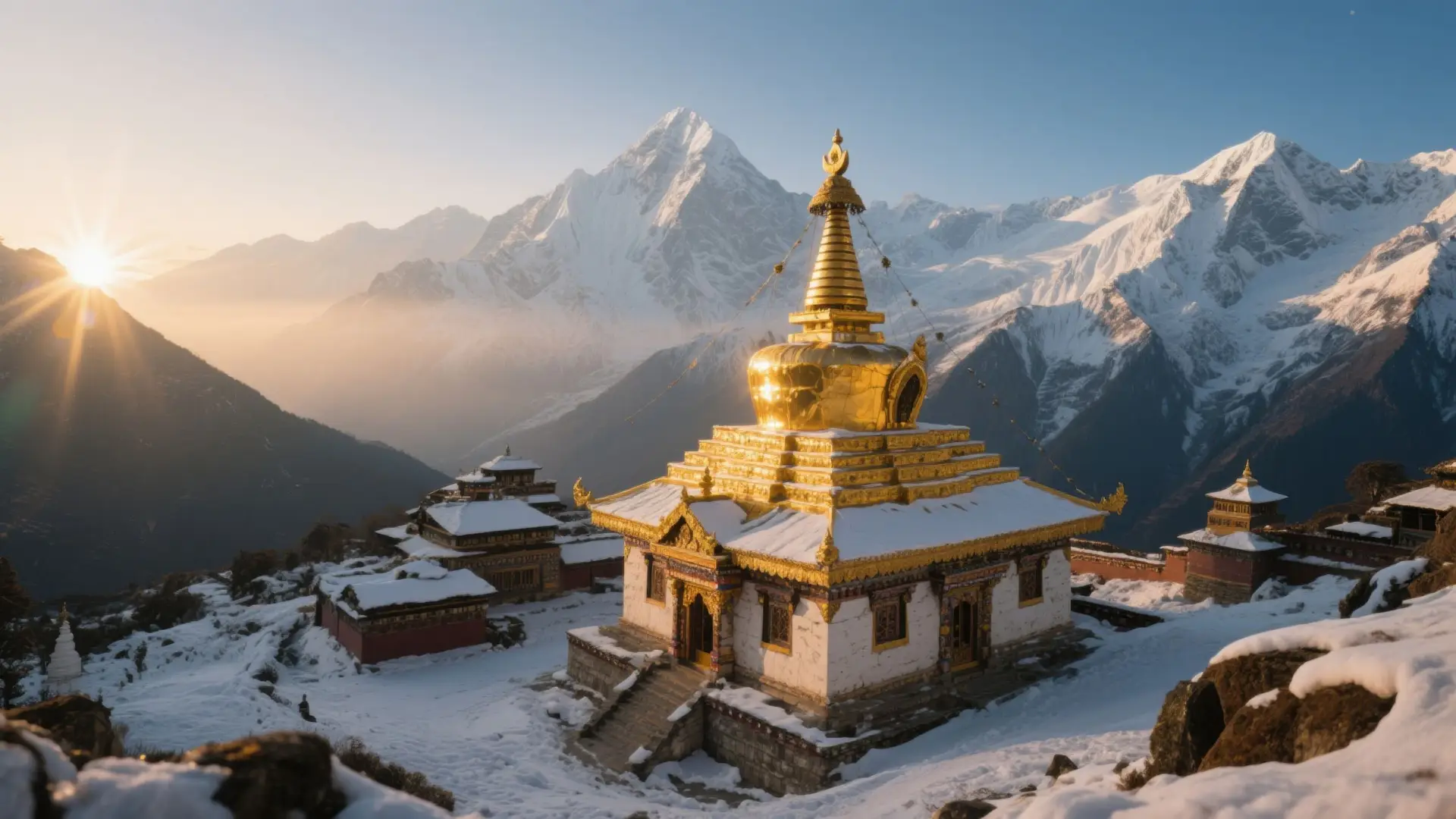
Nepal and Bhutan are not only scenic destinations. They are living fields of tradition, art, sacred geography, ecological restraint, and spiritual memory.
For Xinyue and Tony, these places offer conditions that are increasingly rare in modern life: a slower rhythm, a close relationship with nature, visible religious life, artistic continuity, and communities where happiness is not only measured by consumption or speed.
That does not mean these countries should be romanticized. Poverty is not spirituality. Hardship is not enlightenment. A lack of convenience does not automatically make a place wise.
But places like Nepal and Bhutan can still ask us uncomfortable questions.
Why do we have so much more, and yet feel so tired?
Why do we live with such convenience, yet speak so little about happiness?
Why do people with fewer material comforts sometimes seem to carry more light in their eyes?
Those questions are where retreat-travel begins.
How Nepal and Bhutan Found Xinyue and Tony
Lynn
Tony, Xinyue, I’m so glad we have this chance to sit down together. I don’t really want to call this an interview. I see it more as a conversation between us.
Your experiences are so unique, and in some way so complete, that I feel many people may find inspiration from your lives.
So I want to begin with something I’m personally curious about.
How did you two become connected with Nepal and Bhutan? Did you actively choose these two places, or did certain causes and conditions choose you?
Xinyue
I’ll answer that.
For me, Nepal began with art. At the very beginning, I was deeply drawn to thangka painting and sacred sculpture. If we trace these traditions back, Nepal is one of their important origins.
About twenty years ago, I first entered Nepal through a study-travel opportunity. After that, I lived and worked there. Over the years, I went back and forth for more than a decade, and I actually settled there for seven years.
So my connection with Nepal is very deep. Its people, its spiritual heritage, its culture, and its art have all nourished me profoundly.
As for retreat-travel, it started very simply. At first, there was a platform in Wuhan. They had a group of people who wanted to go to Nepal, and they wanted to experience it in the form of retreat-travel. Through friends, they found Tony and me.
Tony and I discussed it. For me, it felt very natural — almost like sharing an important part of my own life with others.
With Nepal, I already had deep feelings, deep knowledge, and a strong personal connection. With Bhutan, the connection also came through art and culture. And I also have another background: I have twenty years of outdoor public-welfare experience and experience leading groups outdoors. So many of my interests and strengths naturally came together.
After Tony and I talked it through, we happily said yes. That was how the causes and conditions began.
“For me, retreat-travel began almost like sharing an important part of my own life. Nepal had nourished me through its people, art, culture, and spiritual heritage. When the conditions came together, it felt very natural to share that part of my life with others.”
— Xinyue
Lynn
That’s beautiful. So perhaps we can say it was both: there was your own active choice, but also a gathering of conditions.
Even if there was a passive element, it was not a weak kind of passivity. It was a joyful and natural acceptance. It sounds like a kind of surrender — where you bring your own gifts, your talent, and your life experience into a larger current.
It feels very natural, very complete, like water flowing into a river.
Xinyue
Yes. Exactly.
Everest, Environmental Work, and the First Taste of Awe
A Young Artist Meets the Himalayas
Lynn
You mentioned your outdoor experience very modestly. But when you say “outdoor experience,” we are actually talking about climbing in the Himalayas — and not recently, but almost twenty years ago.
In 2007, this was not something widely understood by the public. Many people might have seen it as risky, even irresponsible. But you had already begun that journey.
Could you share more about that? Were there moments when you felt close to life and death?
Xinyue
Looking back, around 2007, I was very young.
At that time, I certainly did not have the clarity I have now about life or about the direction of my life. Only after reaching this age, after many years of settling, practicing, and being refined by life, can I now speak about these things clearly, almost like chatting at home.
Back then, I was actually quite hazy.
My connection with the Himalayas began through environmental protection. At that time, CCTV and several companies launched an environmental initiative related to Everest and the “Third Pole.” They were recruiting people publicly.
I loved climbing. I studied art, so I also loved fieldwork and sketching from life. And I was deeply drawn to the plateau, though I had very little experience there at the time.
I was young. It came from interest, impulse, and longing for the highlands. So I joined.
I was very lucky to be selected from a very large pool of applicants. I feel it was heaven giving me a chance. I was honored to become part of that project.
That was my first time climbing in the Everest region, reaching an altitude of about 7,200 meters.
At the time, I did not feel particularly afraid. Maybe that is the fearlessness of youth. My life was full of adventure then — a young person’s heat and curiosity, a longing for the plateau, and a desire to explore mysterious cultures. That was how I entered that journey.
Now, looking back, I feel there must have been some hidden arrangement. That was how my bond with the Himalayas began. I feel very grateful for that experience.
What the Mountain Teaches
Lynn
And at 7,200 meters, especially back then, the technical conditions and public knowledge around mountaineering were not what they are today.
Xinyue
Actually, for me, it was a very comfortable process.
The reason I say that is because it was not an individual action. In the Everest region, you absolutely need professional mountaineers and professional teams to support you. Our whole group was part of this organized project, so the team structure and support system were very complete.
We worked together with the Chinese Mountaineering Team and the Tibetan Mountaineering Team. Our lead guides were national-level mountaineering heroes. Many of the country’s major Everest expeditions had been led by them.
So for me, it was an extraordinary learning opportunity. We completed the mission under their care and protection.
At that age, I had the chance to learn about the plateau from true professionals. I learned how serious mountaineering is. I learned reverence.
Before that, I may have simply seen it as a hobby. But through that experience, I understood that it is a serious discipline, a serious relationship with nature. I developed a sense of awe toward the natural world.
That was also a kind of blessing.
Lynn
So for you, it was not merely a huge physical challenge. It was also enjoyment, training, and even a sweet kind of refinement.
Xinyue
Yes. It has been many years now. But when I look back, I remember the excitement of that first journey. We prepared a lot, and at every stage we were guided and protected by professionals. So in memory, it feels like a very enjoyable process. A sweet memory.
Tony, Small Mountains, and the Problem with Labels
Lynn
Tony, do you also have mountaineering experience?
Tony
Only small mountains.
Xinyue
But in some sense, high mountains and small mountains are not different.
Tony also loves outdoor activity. He used to do self-driving trips and led off-road teams. He has also planned many events. So the two of us complement each other well.
I have more experience with highlands and mountains, while Tony is very strong in event planning and overall structure. He also has experience with cross-border self-driving journeys.
Lynn
Tony is very humble.
Xinyue
Yes. He speaks very little. Very low-profile. But he is a treasure-house. We have to open it slowly.
When a Teacher Refuses the Title
Lynn
Your experiences are quite rare. In your generation, you walked a road that most people did not walk. You both have deep backgrounds in art, creation, outdoor life, and spiritual exploration.
So if we had to introduce you to a broader audience — and I know labels are always limited — Tony, what identity do you feel most comfortable with?
My first thought might be “sound healer,” but I’m not sure that’s accurate.
Tony
Sound healer… I wouldn’t really say that. I don’t feel it is very professional to call myself that.
In general, I don’t like labels very much.
I’m just an ordinary person. A person who can feel. Someone who can communicate in certain ways — for example, by sitting down, having a cup of tea, and having a deeper conversation.
Maybe that is the role I can play.
I don’t have any very special talent. I don’t have as rich a life experience as Xinyue. Everyone has a different focus. My focus is more within my own way. I hope to have deeper communication with people through my own life experience, or my own inner experience.
My experience is more inward.
“I do not really like labels. I am just an ordinary person, someone who can feel, someone who can sit down, drink a cup of tea, and have a deeper conversation through life experience and inner experience.”
— Tony
Lynn
That is exactly why the label fails.
Tony is the kind of person who does not actually need to speak much. He has a stabilizing presence — like the mythical needle that holds the sea still. He just sits there, and something is already being held.
Of course, once I say this, I have created another label. That is the problem with language. It is useful, but it is also guilty.
Spiritual Aesthetics: Using Form to Approach the Formless
Lynn
Xinyue, I feel you are more willing and more able to let energy move into language.
My sense of you is that you are an artist, a designer of energetic space, perhaps even a kind of healer — though again, all these words are limited.
In Fanjing, I feel that you two have naturally chosen, or perhaps been chosen, to use sound, color, art, design, space, and even the arrangement of time to express certain inner states.
So I want to ask: in building this space, have you experienced confusion, insecurity, or friction? How do you use form to approach the formless?
Tony
That is a very good question.
Everything we present in the space — the colors, the objects, all the things you can see — they are all supports on the path of practice. They are conditions we borrow.
What we truly want to express in this space is a core idea related to practice.
All of our language, all of our cognition, has great limitations. These limitations cannot bring us to ultimate reality. Practice is about breaking through these obstacles and approaching that reality.
So for practice, space can become a support. It can help people enter a certain state more easily. We hope to give ordinary people and practitioners a field of stillness — a kind of environment that helps them slowly enter a state closer to reality.
That is the core intention behind this space.
We want to create a jing — a realm, an environment — that offers support for understanding life and walking the path of practice. We hope it can help people break through old patterns of cognition.
At the same time, we hope more fellow travelers can gather here, so that we can walk forward together on a proper path.
Why Beauty Matters
Beauty is not the destination.
Beauty is a doorway.
And like all doorways, it should not be worshipped too much. Otherwise, we may stand at the entrance forever, admiring the woodwork, while forgetting to actually enter.
Retreat-Travel Versus Tourism
Practice Comes First, Travel Comes Second
Lynn
Now I want to return to your retreat-travel project.
From what we have discussed, it is clear that this is not a commercial project in the ordinary sense. Its origin is very different. It comes from your own life experiences, and then through the gathering of causes and conditions, it has become a real retreat-travel group rooted in spiritual exploration.
So when you operate this project in the practical world, how do you design the experience? And since we are now back in the world of form, there must be challenges. What kinds of challenges have you encountered?
Xinyue
Many. Truly many.
First of all, a journey already breaks through the boundaries of an indoor space.
The Chinese word we use is lüxiu — travel-practice. It sounds as if travel comes first and practice comes second. But in its true meaning, practice comes first, and travel comes second.
Traditional travel is more of an outer experience. We travel because we are interested in a destination — its culture, landscape, history, and so on. It is more external, more about behavior and movement.
But retreat-travel is different. The itinerary is only the background. The real core is inward. It returns to your consciousness and your heart. It is an experience of feeling.
In a way, it leads the heart through a certain dimension.
And that is not easy.
To lead such a journey, the facilitator must have a deep understanding of retreat-travel itself. Only then can one design it, initiate it, and complete it.
Another important point is this: when people join the journey, I prefer to call them companions rather than students.
Once the conditions arise and they join us, how do we accompany each heart? How do we allow the journey we designed to help their hearts release, awaken, or open in some way?
Of course, it is very difficult to make someone fully awakened through a short journey of ten or fifteen days. But if we can awaken even a small part of them, if in a high-energy field they can experience some degree of opening, then that is already a very high aspiration.
We do not think we are great. We do not think we have enormous power.
We are designers, facilitators, and most importantly, companions and servants. That is our intention.
“The itinerary is only the background. The real core of retreat-travel is inward: returning to consciousness and the heart. We are not trying to make someone enlightened in ten or fifteen days, but if even a small part of the heart awakens, that is already a very high aspiration.”
— Xinyue
Why Nepal and Bhutan Ask Different Questions
Happiness, Ecology, and the Practice of Subtraction
Xinyue
For Nepal and Bhutan, one of the first things to understand is that they are not highly industrialized places. From an environmental perspective, they are vastly different from the world we are used to.
Most of us now live very fixed lives. Eighty or ninety percent of people work in very regular patterns. Most of our effort goes toward nourishing the body and maintaining life: what kind of house we live in, what food we eat, what clothes we wear, what education we give our children, what medical care we provide for our parents.
These are all important. But most of our energy is spent satisfying the outer needs of the body and life.
A retreat-travel journey may last only ten or fifteen days. In the span of a life, it is almost nothing.
But within those ten or fifteen days, we hope not to preach through language. Instead, we place people into a journey that may shift the trajectory of their lives. We let their whole being temporarily step out of the old track.
Why Nepal and Bhutan?
Because compared with many countries with strong GDP, they may seem economically small. But in terms of cultural preservation and environmental protection, they are extremely precious.
Bhutan is especially known for its ecological protection, high forest coverage, and very low industrial pollution. In an age of explosive information, rapid technology, and AI acceleration, how do such places sustain themselves without rushing down the path of expansion?
It is not that they have no contact with modern information. They do. But they have not rushed to keep adding. In many ways, they practice subtraction.
They preserve tradition. They maintain the link between human beings and nature. They sustain an order that is closer to the pre-industrial rhythm of life.
This gives us a very important question: what supports them? What is their belief system?
Bhutan is also known internationally for placing Gross National Happiness at the center of national development. When we go there, we are shaken by a certain state of being. Where does their happiness come from?
When we look back at our own lives, we see that we live in an age of great material abundance and convenience. We have ride-hailing apps, food delivery, all kinds of technology and services.
But we talk about technology, efficiency, consumption, entertainment, and food — yet we rarely talk seriously about happiness.
I’m from the generation born in the 1970s. I sometimes feel that when we were children, happiness was something people truly talked about and experienced. Today, it feels forgotten.
So before people travel with us, and during the journey itself, we raise this question for them again and again. We invite them to search for their own answer.
We are only facilitators, companions, and servants.
The Place Where the Heart Can Rest
Lynn
Tony, Xinyue has spoken more from the level of vision. On the practical level, how do you make it real? What makes your journey different from other retreat-travel groups?
Tony
Xinyue spoke about the original intention behind what we do.
My own understanding is this: practice is the practice of life. Practice is not homework outside of life. It is life itself.
So retreat-travel can be understood as practicing while traveling. Or, to put it another way, finding the place where the heart can rest while we are on the road.
This is the foundation of how we design the journey.
The places we go are not very developed. Materially, people there may have much less than we do. But what we see is that their state of life can be very moving. It feels a little like our childhood.
They may be poor, but there is light in their eyes — especially in the eyes of children.
We do not tell people this through preaching. We bring them there to see it directly.
So in our design, we try to present these important messages through experience.
At every place we visit, we do not only explain historical sites, sacred temples, culture, architecture, or art. More importantly, we bring people into contact with local life. We let them see the state of local people, taste their food, feel their way of life, and experience all these details through their own senses.
These experiences naturally bring reflection.
Why do they have less than we do materially, yet seem to suffer less than we do?
Why do we have so much more comfort, but remain so tired, so anxious, so unhappy?
So these moments are deliberately placed throughout the journey.
At the same time, beyond seeing and sensing the world through the five senses, we also arrange certain practices and courses. These are like the final brushstroke that brings the painting alive.
For example, sound healing. Through sound, we approach something closer to reality, closer to the essence of life and existence.
In sound, many things fall away. The world begins from silence. When we return to that silence, we can perceive everything more deeply.
“Practice is not homework outside of life. It is life itself. Retreat-travel means practicing while traveling, finding the place where the heart can rest while we are on the road.”
— Tony
Meditation, Sound, and Silence
Tony
Another example is meditation.
Nepal and Bhutan are among the world’s important sacred places for meditation. In such environments, you see people from many countries and many skin colors practicing the same ancient wisdom of life.
When participants enter that kind of field, they begin to feel the real charm of Eastern wisdom.
Interestingly, today many of those deeply attracted to this wisdom are Westerners. They go there to study, meditate, and enter a profound state of life. For many participants, this is very striking. They suddenly realize: this is completely different from what I knew before.
Of course, besides the spiritual elements, we also try to make the arrangements for food, lodging, and transportation comfortable and reassuring. The body must relax first. Only when the body relaxes does the heart have a chance to experience each thing, each person, and each moment of the journey.
From our past journeys, the moments that touched people most deeply were often these small points. They are why people feel the journey was truly worthwhile.
Many participants come once, then want to come a second time, even a third time. Because each journey brings something different. These kinds of insights are difficult to receive in their original living environment. Once they step out, they see a vast world they had not seen before — and that world reflects back into their own life.
“In sound, many things fall away. The world begins from silence. When we return to that silence, we can perceive more deeply what life and existence really are.”
— Tony
Kathmandu as a Living Museum
The Aesthetic Dimension of Spiritual Travel
Xinyue
I’ll add one or two things.
Because I am an artist, and Tony used to work in advertising and film, our emphasis on aesthetics and content is quite different from ordinary travel groups.
The first difference is aesthetic.
The thangka painting and sculpture traditions of Nepal and Bhutan are among the finest in the world, and they are also among the origins of these traditions. Their preservation of art, history, architecture, painting, and sacred sculpture carries tremendous value.
Kathmandu itself is a natural museum.
It is not a museum in name. The whole city is a living museum. It has seven World Cultural Heritage sites. The city itself is a huge living museum.
But this kind of beauty needs deep interpretation. It cannot be understood through superficial check-in tourism.
The second difference is resources.
Because I have more than seven years of lived experience in the southern and northern Himalayas, especially Nepal and Bhutan, I have deep personal relationships with many local artists, spiritual practitioners, and contemplatives.
So we can design many unexpected surprises — whether at the academic level or through deeper cultural connections. These are things ordinary local travel groups may not easily provide.
“Kathmandu itself is a living museum. It is not a museum only in name; the whole city is alive with culture, art, history, architecture, and sacred presence. But this beauty needs deep interpretation, not superficial check-in tourism.”
— Xinyue
Inner Transformation and the Gate of Life and Death
Retreat-Travel for People Without a Spiritual Background
Lynn
I heard feedback that many retreat participants felt a transformative force — a kind of overturning of life circumstances or cognitive structure, almost a sense of “I can never go back to the old way.”
Is this common in your journeys? Does it depend more on each participant’s own causes and conditions, or does it come from the journey itself? Or is it a co-arising of both?
Xinyue
It is actually quite common.
In our groups, some participants already have a foundation in practice, while others have no spiritual background at all.
Lynn
That is very interesting.
For those who have never experienced retreat-travel, spiritual practice, or even religion — people who may just be curious, or simply want to rest and adjust their hearts because life has brought them difficulty — how do you awaken and accompany them?
Xinyue
Across our three retreat-travel journeys, the age range has been very wide. Our oldest participant was in their seventies. The youngest participants were eight, twelve, or thirteen years old.
For older participants, these journeys can bring very deep shock and transformation. As people age, they often care most about physical and mental health, and about how to face impermanence.
Nepal and Bhutan are places that place great importance on spirituality, karma, life, and death.
For example, our second journey had the theme “Passing Through the Gate of Life and Death.” Through local understandings of death, especially in the Hindu tradition in Nepal, we led participants into certain rituals.
Local views of death are very different from ours. In China, people usually have graves. In the West, there are similar ideas. But in Hindu tradition, after cremation, ashes may be placed into a sacred river.
We brought participants to witness this kind of ritual. It became a very important theme in that second journey.
There were also evening rituals, prayers for the deceased, and priestly ceremonies. If we only explain these through words, the impact is limited. But when you are physically there, the topic of life and death touches you directly and vividly.
The whole group was deeply shaken.
One participant, after returning home from that journey, soon faced the death of an immediate family member. Later, she told us that the support she had received from the journey was difficult to describe in words. It helped her pass through a major life challenge in a very important way.
So for many people, especially when they face life’s suffering and impermanence, retreat-travel can offer profound spiritual nourishment and support.
That is one of our original intentions.
Not a Commercial Project
Xinyue
From the beginning, we did not treat this as a commercial project. It was never our main interest in that sense.
We wanted to share what we had accumulated through our own lives, practice, and inner exploration. Through retreat-travel, we hoped to offer awakening and support to people like us — people who have a need to explore inwardly.
That is why we do it.
We like doing it. We are willing to do it. This is part of the belief that supports us.
Tony
Yes. And the feedback from participants gives us even more strength. It makes us want to bring more people into that field.
There are always many unexpected gains. Their feedback is a great support for us.
Lynn
Yes. It is a relationship of mutual support, mutual collision, and mutual protection. In that process, everyone together verifies something about life’s reality and completeness.
I understand it as co-arising.
When the Hotel Cancels, Practice Begins
Travel Challenges as Spiritual Practice
Lynn
Have you encountered difficulties during the process?
Xinyue
Yes. Many difficulties.
For example, during our first retreat-travel journey, we had booked a very special and well-known meditation-level hotel. It had only thirty-five rooms. We used many resources and booked it a month in advance.
Then, five or six days before the journey began, the hotel manager suddenly told me that the drainage pipes had a problem. The whole hotel had to undergo repairs, and all reservations were canceled.
But our journey was about to begin.
Our course design was linked one part to another. In one journey, we usually arrange three or four carefully chosen hotels, because in Nepal, where tourism is an important part of the economy, hotel culture itself has become a special part of the experience we want to present.
The timing between each hotel is also very tight. And the hotel that had the problem was supposed to host three days of our core courses.
That sudden change was a huge challenge.
But because I had lived in Nepal for a long time and had local resources, we finally coordinated everything quite smoothly.
This kind of thing really tests experience.
The Tiger’s Nest Incident
Xinyue
Another example happened during our third journey in Bhutan. After climbing to Tiger’s Nest, one photographer from China happened to encounter a local festival and a very special ritual. He felt this was a once-in-a-lifetime scene, so he secretly recorded it using smart glasses with a camera function.
But Bhutan is very sensitive about boundaries and rules. At Tiger’s Nest, no photography or filming equipment is allowed. Everyone has to hand in their phones before entering.
He secretly recorded anyway, and was discovered by local security.
The issue became very serious and was eventually escalated to high-level police systems. As the main group leader, I had to accompany him through several places: tourist police, regular police, and then higher-level police.
It really tested our ability to respond on the spot.
Fortunately, it was eventually resolved well.
In every journey, there are usually one or two dramatic, unexpected incidents like this. In a way, they become part of the beauty and story of the journey. Travel is natural, and unexpected events are part of travel.
Lynn
Exactly. Once we are on the road, unexpected things will always happen.
The question is not whether there will be drama. There will be drama. The question is how we respond to it.
Some people collapse when drama appears. Others turn it into an opportunity to positively influence more people.
That is something I see very clearly in the way both of you work.
Xinyue
I believe there will be causes and conditions for you to experience it more deeply in the future.
A Small Pure Land: Meditation Across Cultures
Can Retreat-Travel Point Toward Human Community?
Lynn
We are almost out of time, but I want to ask one final question.
Tony mentioned something very special in your journeys. First, you offer deep cultural immersion — almost like an anthropologist entering local culture. Second, there is the experience of people from different skin colors and cultural backgrounds meditating together, breathing together, and sharing a sense of connected destiny.
We often speak of “human community,” but for most people, that phrase feels very far away, almost unreachable.
Perhaps only in such a field, when we return to something original in human nature, can we truly feel it.
In today’s world, this seems very meaningful. Is it possible for Eastern and Western cultures, or even humanity more broadly, to move toward a true shared destiny? Can we transcend culture, religion, skin color, and background, and find a real sense of human community?
And from that basis, can we reduce war, opposition, and conflict?
In your retreat-travel group, I saw a possibility — a small Pure Land. Small, but real and powerful.
Can you share more about this?
Tony
This is a very large topic.
What we see in the world today is still a great deal of confrontation, especially in the current political environment. The confrontation between East and West is becoming more obvious.
At the same time, the East, especially China, is in a period of renewal and revival. And we also see that since the 1950s and 1960s, the West has already been turning toward the East — toward Eastern wisdom.
Many Westerners are already practicing this wisdom.
When we go to Bhutan and Nepal, one very direct impression is that many excellent meditation places have very few Chinese or Chinese-speaking practitioners. Instead, many Westerners are there, and they are very diligent.
This is worth reflecting on.
Of course, our own retreat-travel work is very small. The number of people we can bring is limited. But we hope that through this kind of action, even if just one or two people rediscover the best things in our own tradition and begin to practice them, the force will slowly grow.
This is also a core part of Eastern traditional wisdom and spiritual practice.
We are using a convenient method — maybe even a curved method. We first bring people to a foreign place, let them directly feel something there, and then they return to their own country and their own lives, where they can rediscover the core of Eastern wisdom and practice it.
That is a very important intention for us.
Tony
Personally, I have always been practicing in this direction. I have always been interested in Chinese traditional culture and traditional wisdom.
After I truly entered this path, especially after going to Nepal, that sense became stronger. You discover that this wisdom can truly help people transcend boundaries between races and nations.
The ordinary people of Nepal and Bhutan are very peace-loving. They are not peoples who love conquest, plunder, or invasion. This has nothing to do with the size of the country. It is a cultural quality.
At its root, Eastern culture also loves peace. It does not advocate conquest or plunder.
So from this perspective, even if what we do is very small, it is still a real contribution to world peace.
In different countries and meditation centers, we saw people from all over the world. They were humble, peaceful, settled, and respectful as they practiced Eastern wisdom.
This also moved us deeply. It made us feel: some people are already walking ahead, and they are walking very well.
So we also need to be more diligent. We need to recover what we originally had but somehow lost. We need to recover the state of life that each of us should originally have.
That is my feeling.
Xinyue
I would add that in the beauty of art, in the deep connection between human beings and nature, and in the pure energy of places like the Himalayas, there is actually no cultural difference, no religious difference, and no racial difference.
The energy of the Himalayas is, in a sense, one of the purest fields in the world. Many human-made divisions are softened there, even dissolved. It naturally carries a sense of human unity.
Especially in Nepal and Bhutan, faith is at the center of life. In today’s world, countries that still protect their traditions and cultural inheritance with such national commitment are very precious.
And I do not say this only because I am Chinese or Eastern. As a human being, I feel respect for such places.
What I long for is also what human beings long for together: happiness, beauty, reverence for nature, environmental respect, and the exploration of the eternal question of life.
These are shared human directions.
“In the beauty of art, in the connection between human beings and nature, and in the pure field of the Himalayas, many cultural, religious, and racial differences soften. What we long for is also what human beings long for together: happiness, beauty, reverence for nature, and the search for life’s meaning.”
— Xinyue
The Treasure Outside and the Treasure Within
Xinyue
Retreat-travel has another important meaning: it can break barriers.
It loosens us from the giant self we live inside. It allows us to return to nature, return to tradition, and return to our original face.
In that process, we can find the return between human beings and the heart, between human beings and nature, and between human beings and beauty.
This is a very ultimate experience. It is also the unique value that retreat-travel can bring in a very immediate way.
I am very grateful for today’s conversation.
Even if someone only comes across this video by chance, hears these voices by chance, or learns that people like us are doing retreat-travel — if you feel a connection, you can participate naturally and bravely.
You only need to take ten or fifteen days out of your life, and you may return to a new possibility.
We can go together to discover and explore countries very different from our usual work and life. We can search for treasure together.
But the treasure is not only the outer landscape.
More importantly, it is the inner treasure.
We allow the heart to flow again. We allow the soul to temporarily forget its worries and enter a pure exchange.
This may happen through a singing bowl healing session. It may happen through a rare moment of connection with a snow mountain. Or it may happen when you look at a building that suddenly touches your soul and gives rise to deep reflection.
I think this is one of the most meaningful values of retreat-travel.
Lynn
Beautiful. I feel there are still so many treasures to uncover. We will look forward to continuing next time.
Xinyue / Tony
Yes.
Final Reflection: The Road Is Not Separate from Practice
What stayed with me after this conversation was not only Nepal, Bhutan, Everest, Tiger’s Nest, meditation centers, thangkas, singing bowls, or the phrase “small Pure Land.”
What stayed with me was the quiet honesty of the path itself.
Xinyue did not arrive at this work through a straight line. She entered through art, the Himalayas, environmental work, years of living in Nepal, and a long relationship with culture and place.
Tony did not try to become a spiritual personality. He resisted labels. He spoke of tea, conversation, inner experience, silence, and the simple possibility of helping people find a place where the heart can rest.
Together, they remind us that retreat-travel is not tourism plus meditation.
It is not a vacation with incense.
It is not a spiritual product with a mountain backdrop.
At its best, it is a temporary interruption of our usual life — a small opening where we can see what we have forgotten.
We may discover that we have more comfort than ever, but less rest.
We may discover that beauty is not decoration, but a doorway.
We may discover that children with light in their eyes can become teachers.
We may discover that a hotel cancellation is also practice.
We may discover that death is not a concept, and neither is happiness.
We may discover that the world is much larger than our habits.
And perhaps most importantly, we may discover that the real journey does not end when we return home.
The road continues in the city, in the family, in the inbox, in the tired body, in the ordinary morning, in the next difficult conversation.
After all, as Tony said, practice is not homework outside of life.
It is life itself.
And sometimes, to remember this, we have to leave home for a little while.