Why We Sometimes Need to Go Far Away to Meet What Has Always Been Here
Pilgrimage can take us to Nepal, Bhutan, India, mountains, temples, and sacred rivers. But the real journey is not only across geography. It is the slow discovery that the sacred was never limited to a place.
This essay is a reflection on Buddhist pilgrimage, sacred places, and the strange generosity of the road. It is also a reflection on my conversation with Xinyue and Tony, two practitioners whose lives have been shaped by Nepal, Bhutan, the Himalayas, art, silence, and travel-practice.
I have always loved the small pilgrimage text by Dzongsar Khyentse Rinpoche: Best Foot Forward.
Of course, when I say “I love it,” I do not mean I have understood it. That would be much too dangerous. In spiritual life, “I love this book” can very quickly become “I understand this teaching,” and with one small push from the ego, it becomes “I should probably teach a weekend course on this.”
For the protection of sentient beings, I will not do that yet.
What I love about the book is that it refuses to make pilgrimage too polite.
It does not flatter the pilgrim. It does not decorate the path with fake serenity. It does not pretend that holy places exist to satisfy our spiritual taste. Instead, it keeps reminding us that sacred places are often dusty, crowded, confusing, inconvenient, and sometimes deeply humiliating.
Which is to say: they are very good for us.
What Is Buddhist Pilgrimage Really For?
Pilgrimage Is Not Just Visiting a Holy Place
We usually imagine holy places as quiet, fragrant, clean, and tastefully lit.
Ideally, there should be a soft breeze, a few prayer flags moving in the background, and perhaps a monk who looks ancient but has excellent skin. If possible, the Wi-Fi should work, but only for uploading spiritual photographs, not for checking email.
But holy places are rarely obedient to our aesthetic fantasies.
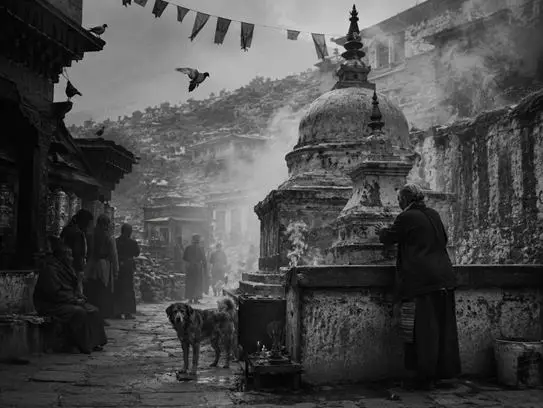
They can be dusty, crowded, noisy, hot, confusing, and sometimes a little humiliating. In fact, humiliation may be one of their most reliable blessings. Nothing cures spiritual fantasy quite like realizing that we are still annoyed by the toilet, still worried about breakfast, still comparing hotels, and still hoping someone will take a good photo of us looking humble.
A Holy Site Is Not Made Sacred by Cleanliness
The book makes a point that is both funny and severe: a holy site is not powerful because it has been polished into a museum. It is powerful because devotion, memory, practice, and awakening have gathered there for centuries.
A holy place is not made powerful by carpets, perfect lighting, or museum-like order. It becomes alive through devotion, practice, memory, and the countless beings who have turned their minds toward awakening there.
This is useful for modern pilgrims like us.
We live in a world trained to expect comfort. We want spirituality, but not too much dust. We want transformation, but preferably with a clean bathroom. We want impermanence, but not involving our luggage.
Unfortunately, the path was not designed by a luxury hospitality consultant.
The Sacred Is Not Limited to Geography
At one point, the book reminds us of a simple and inconvenient teaching attributed to the Buddha:
“Whoever thinks of me, I am in front of them.”
This is beautiful.
It is also extremely inconvenient.
Because if the Buddha can be present wherever we remember him, then strictly speaking, we do not need to run around the world searching for holy places. Our kitchen can be holy. The airport security line can be holy. The moment we are angry because someone has not replied to our message can be holy.
Even our inbox can be holy, though I admit this one may require a much higher level of realization than I currently possess.
Why We Still Need to Go Somewhere
The problem is not the teaching.
The problem is us.
Most of us do not quite believe that the sacred can be right here. We have clever minds. Clever minds are very useful for booking flights, optimizing credit card points, and creating elaborate reasons why our laziness is actually “self-care.”
But clever minds are not always good at devotion.
So we go somewhere.
We go to Bodhgaya, Sarnath, Lumbini, Kushinagar. We go to Nepal, Bhutan, India, Tibet, Japan, Thailand, mountains, monasteries, caves, temples, rivers, ruins, retreat centers, and places where our ordinary life briefly loses its grip.
In theory, we do not need to go anywhere.
In reality, most of us need to go somewhere in order to realize that truth was never somewhere else.
Ben of Kongpo and the Problem of Being Too Sophisticated
When Devotion Makes a Statue Speak
This is where the story of Ben of Kongpo becomes so wonderful.
Ben travels all the way to Lhasa to see Jowo Rinpoche, one of Tibet’s most sacred images of the Buddha. But Ben is not sophisticated. He sees offerings and butter lamps around the statue and assumes they must be food for this nice lama. So, being practical and polite, he eats some.
Later, he wants to circumambulate, but he needs to take off his boots and does not know where to put them. Naturally, he leaves them with the nice lama.
A temple caretaker returns and is horrified to find Ben’s dirty boots sitting at the feet of Jowo Rinpoche. As he tries to remove them, the statue speaks:
“Kongpo Ben has entrusted them to me.”
This is the kind of story that destroys all our good manners.
We might have perfect etiquette in temples. We may know where to put flowers, how many times to bow, which mantra to recite, and how not to embarrass ourselves. But perhaps Jowo Rinpoche is less interested in our etiquette than in whether we have any trust.
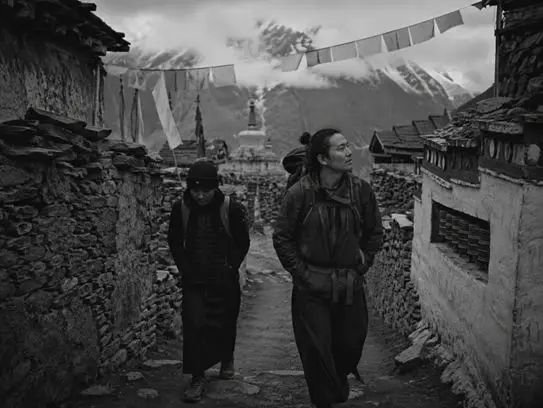
The Lesson of Ben’s Boots
Ben’s devotion was not elegant, informed, or socially correct. It was simple enough to cross the boundary between statue and presence, between ritual object and living Buddha.
Ben did not go to Lhasa to perform spirituality.
He went because he longed to see the Buddha.
His mind was simple enough to make a statue speak.
Most of us are not like Ben. If I left my shoes at the feet of a sacred statue, I would not hear the Buddha speak. I would probably receive a very direct teaching from temple security.
And I would deserve it.
The Point Is Not to Behave Badly in Temples
This story is not telling us to behave badly at holy sites.
Please do not use Ben of Kongpo as an excuse to eat offerings.
The point is more subtle, and more disturbing: a holy place is not made holy by our concepts of holiness. It becomes holy through devotion, openness, and the collapse of the ordinary boundary between here and there, sacred and profane, statue and living presence.
The real question is not: do we know the rules?
The real question is: do we still have the capacity to be moved?
Lodro, Mañjushri, and the Pig on the Rubbish Heap
Looking for Wisdom in the Wrong Costume
Then there is the story of Lodro, who went searching for Mañjushri.
Lodro hears that Mañjushri has promised to appear to anyone who travels to Mount Panchashisha. He becomes so inspired that he can hardly sleep. He begs his teacher for permission to go. The teacher tries to discourage him, because the journey is dangerous and unnecessary.
But Lodro insists.
This is already very familiar. Many of us also ignore good advice when our spiritual ambition has become romantically activated.
So off he goes, across rivers, deserts, heat, animals, hardship, and probably many moments of regretting his own devotion.
He arrives.
He searches everywhere.
No Mañjushri.
Instead, he ends up in a lively place full of drinking, joking, and noise. A group of Chinese boys mock him for believing he might see Mañjushri. Eventually, one of them gives him a letter to deliver to Mongolia. Lodro, somewhat defeated, carries it all the way there, only to discover that the recipient is not a noble master in silk robes, but a fat pig sitting on a rubbish heap.
The pig reads the letter, weeps, and dies.
Lodro finally reads the message.
It is from Mañjushri.
This Is a Very Buddhist Kind of Comedy
We go looking for wisdom on a mountain, and wisdom sends us to a pig on a rubbish heap.
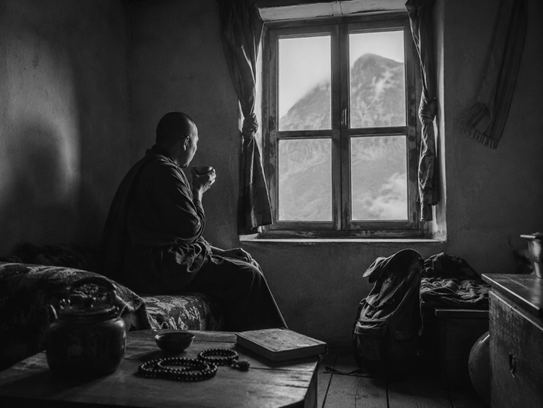
We expect a bodhisattva to appear with a golden aura and a sword of wisdom. Instead, he appears as a rude boy in a bar, a misleading letter, an absurd errand, and a dead pig.
This is why one must be careful with pilgrimage.
It may work.
Not in the way we want, of course. That would be too vulgar. It may work by ruining our idea of how it should work.
Pilgrimage may not give us the vision we planned. It may instead dismantle the one who planned it, until even a rude boy, a failed errand, or a pig becomes a messenger.
Lodro’s journey may have been unnecessary from the highest view, because Mañjushri’s compassion is not limited to a mountain. But without going to the mountain, Lodro may never have discovered that.
The outer journey was unnecessary and completely necessary at the same time.
This is one of those Buddhist conclusions that makes perfect sense after we stop trying to make it make sense.
Xinyue and Tony: When a Life Becomes a Pilgrimage
Nepal Began with Art
This brings me to Xinyue and Tony.
When I asked them how they became connected with Nepal and Bhutan, I expected perhaps a neat answer.
A spiritual mission.
A clear calling.
A dramatic moment of destiny, preferably involving a mountain, a dream, and some cinematic lighting.
What came instead was much more interesting.
For Xinyue, Nepal began with art.
She loved thangka painting and sacred sculpture. She was drawn to the lineage of forms, colors, faces, gestures, and presences that have carried Buddhist imagination for centuries.
Around twenty years ago, through study and travel, she first entered Nepal. Then she lived and worked there, returning again and again, eventually spending seven years there.
Nepal became not a destination, but a part of her life.
This is already a teaching.
Sometimes the path does not begin with religion.
Sometimes it begins with beauty.
A line in a thangka. The curve of a bronze face. The stillness of a temple courtyard. The strange feeling that a painted eye is looking at you more honestly than most human beings do.
We think we are “interested in art.”
But perhaps art is just the bait.
The fish is our heart, and the hook is compassion.
When Sharing a Life Becomes a Journey
Later, the travel-practice journeys began almost casually. A group of people wanted to go to Nepal in a more meaningful way. Through friends, they found Xinyue and Tony.
Xinyue described it not as launching a business, but as sharing an important part of her own life.
That phrase stayed with me.
The best pilgrimages often begin like that.
Not with a product.
Not with a campaign.
Not with someone saying, “Let us create a premium spiritual transformation experience for the high-end conscious traveler demographic.”
Thank goodness.
They begin because someone has been nourished by a place and is willing to share the nourishment. They begin because causes and conditions gather. Someone has lived somewhere. Someone else is ready to go. A friend introduces another friend. A conversation happens. Tea is served. Someone says yes.
And suddenly what looked like a simple trip becomes a path.
Bhutan, the Himalayas, and Causes and Conditions
A Journey Made of Many Threads
Bhutan entered through another doorway: art, culture, nature, and Xinyue’s twenty years of outdoor public-welfare experience.
She had mountain knowledge, aesthetic sensitivity, local connections, and the ability to hold a journey physically and culturally.
Tony brought something else: event design, structure, silence, and a very understated presence.
When I asked Tony how he would describe himself, he did what truly interesting people often do: he refused the label.
Not a sound healer.
Not a guru.
Not a spiritual brand.
Just an ordinary person, he said, someone who can feel, someone who can sit down with you for tea and have a deeper conversation.
This is very suspicious.
In our age, anyone who resists branding may actually be dangerous to samsara.
Tony is low-key in the way that makes you suspect there is a great deal stored in the basement. Xinyue called him a treasure-house that needs to be opened slowly. I had the same feeling.
Some people do not need to speak much because their presence has already done half the talking. This is very inconvenient for interviewers, because we depend on people saying things. But it is very useful for practice, because it reminds us that speech is not the only form of transmission.
Xinyue, by contrast, allows energy to move into language. She gives form, color, context, and story.
Together, they are an interesting pair: mountain and room, silence and expression, route and atmosphere, stillness and articulation.
The Everest Thread
And their journey, like all real journeys, did not begin with mastery.
Xinyue’s early connection to the Himalayas came through environmental work. In 2007, she joined an Everest-related environmental initiative and was selected from a huge pool of applicants. Young, passionate, drawn to high places and mysterious cultures, she climbed to around 7,200 meters.
Looking back, she describes it with gratitude and a kind of sweetness.
At the time, she was not yet the person who could explain her life clearly. She was, as she said, still somewhat hazy, driven by love, curiosity, and a young person’s fearless longing.
I find this very moving.
Many callings do not arrive as clean instructions.
They arrive as restlessness. Fascination. A strange attraction to mountains. A desire to study art. A chance application. A friend’s invitation. A place that keeps pulling you back.
At first, we may not know whether we are choosing it or it is choosing us.
Probably both.
Buddha Nature, Sesame Seeds, and the Ordinary Person
Siddhartha Was Ordinary, Which Is Terrible News for the Ego
This is why the Buddhist teaching that Siddhartha was an ordinary person is so important.
The Buddha did not begin as a supernatural being descending in perfect glory to rescue the rest of us. He came as a human being. He faced birth, aging, sickness, death, confusion, discipline, temptation, austerity, and doubt.
His awakening matters precisely because it happened through a human life.
If Siddhartha were never ordinary, his path would be beautiful but useless to us.
But because he was ordinary, we are implicated.
This is terrible news for the ego.
It means we can no longer say, “Well, he was Buddha, but I am just me.” The whole point is that the path was walked through human experience, not outside it.
The Sesame Seed Image
This is also where the sesame seed image becomes so helpful.
If there is oil in sesame seeds, then pressing them can produce oil. If there is no oil, no amount of pressing will help. You can spend your life squeezing a stone, and the only result will be a very tired hand.
Buddha nature is like that oil.
It is not imported from outside. It is not delivered by a sacred travel agency. It is not added to us by a mountain, temple, or teacher.
But the right conditions may press us in the right way.
Pilgrimage is one of those conditions.
The path does not add enlightenment to us from outside. It presses what is already possible within us, the way oil emerges from sesame seeds under the right conditions.
Not because pilgrimage magically solves everything.
It will not.
One can go to every holy site in India and still return home fully capable of being irritated by one’s family within forty-eight hours. Sometimes within forty-eight minutes.
But pilgrimage creates pressure.
It changes the atmosphere around the mind.
It removes our usual furniture.
It makes our habits visible.
It gives devotion a landscape.
Faraway Pilgrimage and the Sacredness of Here
Why Far Away Helps
This is why I think pilgrimage can be far away, and it can also be here.
Faraway pilgrimage is useful because most of us are not yet able to see the sacredness of here.
We are too familiar with our apartment, our commute, our partner’s habits, our child’s noise, our own inbox, our own face in the mirror.
Familiarity becomes a dull film over perception.
We stop seeing.
We stop listening.
We stop being surprised that we are alive.
So sometimes we need Nepal.
Sometimes we need Bhutan.
Sometimes we need India, with its dust, cows, gods, broken tiles, holy rivers, cremation smoke, impossible traffic, and ruthless refusal to become Switzerland.
Sometimes we need to leave home in order to realize that home was never the problem.
Why Clean Spirituality Is Suspicious
The book warns us that if holy places became too clean, too controlled, too air-conditioned, too museum-like, something essential would be lost.
I think this is true not only of holy places, but of spiritual life itself.
We want spirituality without flies.
Devotion without inconvenience.
Wisdom without embarrassment.
Compassion without having to deal with difficult people.
Impermanence without losing anything we like.
Unfortunately, the path includes the things that expose us.
The Small Inconvenience Is Often the Teaching
A delayed flight can be a teaching.
A ruined plan can be a teaching.
A hotel problem can be a teaching.
A child interrupting a profound conversation can be a teaching.
A person secretly filming where filming is forbidden can become, for everyone involved, a rather intense teaching on rules, culture, ego, and consequences.
I am not saying we should manufacture chaos.
Samsara is already doing an excellent job.
But when chaos comes, pilgrimage gives us a chance to relate to it differently.
Travel-Practice Is the Real Version of Pilgrimage
Not the Postcard Version
In Xinyue and Tony’s journeys, there were many such moments: logistical crises, sudden cancellations, unexpected dramas, delicate cultural situations, and all the very human complications that arise whenever a group of people travels together with bodies, preferences, fears, and digestive systems.
This is why I trust their understanding of travel-practice more than I would trust a glossy brochure.
They know that travel is not only sacred architecture and beautiful mountains.
Travel is also plumbing, permits, exhaustion, timing, weather, misunderstandings, and the subtle art of helping people not fall apart when their expectations do.
Perhaps this is also pilgrimage.
Not the postcard version.
The real version.
The version where the outer road and the inner road keep interrupting each other.
The Inner Mountain
A mountain calls you.
You go.
At first, you think the mountain is outside. Then, after enough altitude, inconvenience, beauty, fear, and silence, you begin to suspect the mountain has been inside all along.
This sounds poetic.
But before we become too pleased with ourselves, let us remember that the inner mountain often looks like our own pride, impatience, need for control, and fear of being ordinary.
Every Life Has Its Own Route
Do Not Despise Your Own Chapter
Every life is a pilgrimage, but not in a sentimental way.
Not every life looks like Xinyue’s.
Most of us will not live seven years in Nepal, climb toward Everest, lead journeys through Bhutan, or build a space of spiritual aesthetics with a quiet man who refuses to call himself a sound healer.
Most of us will not have such visibly dramatic causes and conditions.
But every life has its own route.
Some people are called by mountains.
Some by illness.
Some by grief.
Some by art.
Some by children.
Some by marriage.
Some by divorce.
Some by burnout.
Some by a book they did not expect to love.
Some by a teacher.
Some by the uncomfortable feeling that success has not delivered what it promised.
Some by an inexplicable longing that refuses to go away, even after many sensible attempts to become a normal person.
We should not despise our own chapter because it does not look like someone else’s.
Ben Had His Boots
Ben had his boots.
Lodro had his donkey, his letter, and his pig.
Xinyue had thangkas, Nepal, Everest, Bhutan, and the gradual gathering of causes and conditions.
Tony had tea, silence, inner experience, and the courage not to inflate himself with labels.
We have whatever is in front of us.
This may not feel like enough.
It rarely does.
The ordinary always looks insufficient until practice begins to ripen.
A kitchen looks like a kitchen.
A difficult colleague looks like a difficult colleague.
A tired evening looks like a tired evening.
Then one day, without much drama, we realize that each of these has been asking us the same question:
Are you awake yet?
Usually the answer is no.
That is fine.
Pilgrimage is not for people who are already awake. It is for those of us who are beginning to suspect that sleep is no longer satisfying.
So Go Far Away If You Need To
Go With Medicine, Humility, and Too Many Expectations
So go far away if you need to.
Go to Nepal.
Go to Bhutan.
Go to India.
Go to the mountains.
Go to the river.
Go to the temple where the floor is not clean enough for your standards.
Go to the place that ruins your idea of holiness.
Go with a book, with medicine, with humility, with too many expectations, and with the willingness to have some of them disappointed.
But do not go only to collect experiences.
Go to be undone a little.
Go to be embarrassed by your own mind.
Go to see what remains when your normal identity has poor reception.
Go to remember that the Buddha was not merely a teacher in the past, but the teaching itself, appearing again and again as condition, interruption, longing, beauty, dust, devotion, silence, and sometimes even a pig on a rubbish heap.
The faraway place is not the final answer. It is a compassionate interruption, a temporary disruption of habit, a mirror held up by dust, beauty, inconvenience, and devotion.
When You Come Home
And when you come home, do not assume the pilgrimage is over.
The faraway place was only kind enough to begin the work.
Now comes the harder pilgrimage:
The inbox.
The family.
The body.
The news.
The aging parents.
The difficult friend.
The anxious night.
The ordinary morning.
If we can meet those with even one percent more openness, the journey was not wasted.
And if we still cannot meet them, perhaps we will need to go far away again.
No shame in that.
Some of us are slow learners.
Fortunately, the path seems to have room for us too.
Final Reflection: Pilgrimage Begins Again at Home
Buddhist pilgrimage is not simply about collecting sacred sites.
It is not about proving that we are spiritual.
It is not even about having a beautiful experience.
Pilgrimage is a method for remembering.
Remembering the Buddha.
Remembering the teachings.
Remembering that awakening happened through an ordinary human life.
Remembering that our own defilements are not our final nature.
Remembering that devotion can be stronger than sophistication.
Remembering that wisdom may appear as a mountain, a statue, a rude boy, a pig, a delayed flight, a temple floor, a snow peak, a conversation, or a difficult morning at home.
The sacred can be far away.
The sacred can also be here.
But if here is too hard, go far away first.
Just remember to come back.